Google Shopping vs Bing Shopping Data: What Changes?
Compare Google Shopping and Bing Shopping data, including product coverage, sellers, prices, rankings, ratings, offers, and how ecommerce teams use structured SERP data.
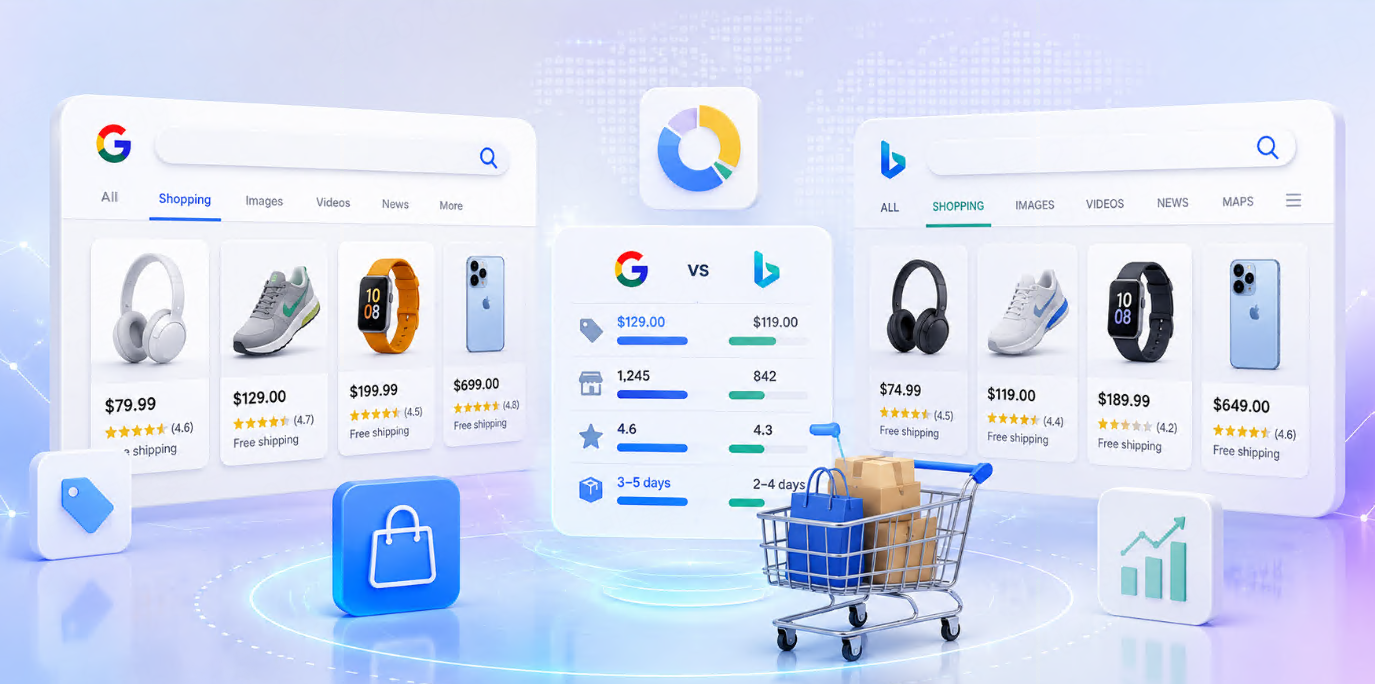



Google Shopping and Bing Shopping both provide product search data, but the results are not always the same. Ecommerce teams may see different products, sellers, prices, ratings, ranking positions, and offer details across the two platforms.
For teams that monitor ecommerce search visibility, this matters. If a product appears strongly on Google Shopping but has weak visibility on Bing Shopping, the team may miss part of the market. If a competitor offers different prices or appears more often on one platform, that can change pricing and positioning decisions.
This article explains what changes between Google Shopping and Bing Shopping data, what teams should track, and how structured SERP data can support ecommerce monitoring.
Why Compare Google Shopping and Bing Shopping?
Many ecommerce teams focus on Google Shopping because it is widely used. But Bing Shopping can still provide useful product and seller signals, especially for teams that care about broader search visibility.
Comparing both sources can help answer questions such as:
Which products appear on both platforms?
Which sellers are more visible on each platform?
Are prices different across search engines?
Do ratings and reviews appear differently?
Which products rank higher on Google but lower on Bing?
Are offer details or delivery messages different?
This comparison gives ecommerce teams a fuller view of search-based product visibility.
What Data Can You Collect?
Google Shopping and Bing Shopping data may include similar field types, but the result structure can differ by platform and provider.
Data Type | What It Shows |
Product Title | Product name shown in search results |
Price | Listed product price |
Seller | Merchant or store name |
Product Link | Destination page |
Image | Product thumbnail |
Rating | Average review score |
Review Count | Number of reviews |
Ranking Position | Product visibility in results |
Shipping / Delivery | Offer and fulfillment context |
Product Details | Attributes, variants, or specifications |
Timestamp | Time of data collection |
The core fields to compare are product title, price, seller, position, rating, review count, and location.
What Changes Between Google Shopping and Bing Shopping?
Product Coverage
The same keyword may return different product sets.
A product that appears on Google Shopping may not appear on Bing Shopping. Bing may show different sellers, different marketplaces, or different product variations.
For ecommerce teams, this means one platform is not always enough to understand product visibility.
Seller Visibility
Seller visibility can also change.
A merchant may dominate Google Shopping results for a product category but appear less often on Bing Shopping. Another seller may have stronger presence on Bing than on Google.
Tracking seller visibility helps teams understand where competitors are strongest.
Useful seller metrics include:
seller appearance frequency
seller ranking position
seller price range
seller review signals
seller coverage by category
Price Differences
Prices may vary across platforms.
The same product can appear with different prices, sellers, promotions, or delivery terms. These differences may come from merchant feeds, market settings, product availability, or platform-specific result selection.
For pricing teams, this is one of the most useful comparison points.
Teams should track:
lowest visible price
average visible price
price by seller
price change over time
price gap between platforms
Ranking Position
A product can rank differently on Google Shopping and Bing Shopping.
Ranking position matters because higher visibility can affect discovery. A product may appear near the top of Google Shopping results but much lower on Bing Shopping.
Teams should compare ranking by keyword, location, device, and date.
This helps identify where product visibility is strong or weak.
Rating and Review Signals
Ratings and reviews may not appear the same way across platforms.
One platform may show review count clearly, while another may show limited reputation signals for the same product. The displayed rating can also vary depending on seller and product source.
Teams should track these fields when available, but avoid assuming both platforms show reputation data in the same way.
Offer and Delivery Details
Shopping results often include more than price.
Offer details may include shipping, delivery speed, pickup options, promotions, discounts, or seller-specific purchase context.
These details can influence user decisions. A lower price may not be better if delivery is slower or the seller has weaker trust signals.
Comparing offer data helps teams understand the full product presentation.
Location and Market Differences
Shopping results can change by country, region, and language.
A product may be visible in one market but not another. Prices and sellers may also vary by location.
For brands selling across markets, location-aware monitoring is important.
How Ecommerce Teams Can Use This Data
Price Monitoring
Compare prices across platforms, sellers, and regions to understand market movement.
Seller Comparison
Track which merchants appear most often and where they are strongest.
Product Visibility Tracking
Monitor whether products appear for important category and brand queries.
Competitive Research
See how competitors position products across search engines.
Market Expansion Analysis
Compare product availability, pricing, and competition across target markets.
AI Ecommerce Workflows
Use structured product data for product matching, pricing analysis, catalog enrichment, and market research.
How to Build a Comparison Workflow
A simple workflow can start with a few steps.
Choose Shared Keywords
Use the same product and category keywords across both platforms.
Examples:
“wireless earbuds”
“running shoes”
“gaming laptop”
“coffee machine”
“standing desk”
Keep Parameters Consistent
Use consistent settings for country, language, location, device, and collection time.
This makes Google and Bing results easier to compare.
Collect Structured Data
Use a SERP API that supports shopping result data. Store fields such as product title, seller, price, position, rating, reviews, link, and timestamp.
Normalize Product Names
Product titles may vary slightly across platforms. Teams may need matching logic to identify the same product across different results.
Compare Trends Over Time
One snapshot is not enough. Monitor weekly or monthly changes to understand real movement.
Talordata SERP API can support ecommerce teams that need structured search result data across multiple search engines.
For Google Shopping and Bing Shopping workflows, teams can use structured output to compare product visibility, sellers, prices, rankings, and regional differences. This is useful for ecommerce SEO, pricing analysis, competitor monitoring, AI product data workflows, and market research.
The main value is consistency. Teams can collect and compare shopping result data in a more repeatable way. 1000 free trial requests>
Final Thoughts
Google Shopping and Bing Shopping data can look similar, but they are not identical.
Products, sellers, prices, rankings, ratings, and offer details may change across platforms.
Ecommerce teams that only monitor one source may miss important visibility or pricing signals.
The best approach is to track both when the market requires it, keep parameters consistent, and compare structured data over time.
The goal is not just to collect more product data.
The goal is to understand where products are visible, how sellers compete, and how search-based ecommerce visibility changes across platforms.
FAQ
Is Google Shopping data the same as Bing Shopping data?
No. Product coverage, sellers, prices, rankings, ratings, and offer details can differ between the two platforms.
Why should ecommerce teams compare both?
Comparing both helps teams understand broader product visibility, seller competition, pricing differences, and platform-specific ranking patterns.
What fields should teams compare?
Teams should compare product title, price, seller, ranking position, rating, review count, product link, location, and timestamp.
Is this useful for AI ecommerce workflows?
Yes. Shopping data from multiple search engines can support product matching, price analysis, catalog enrichment, market research, and ecommerce intelligence.