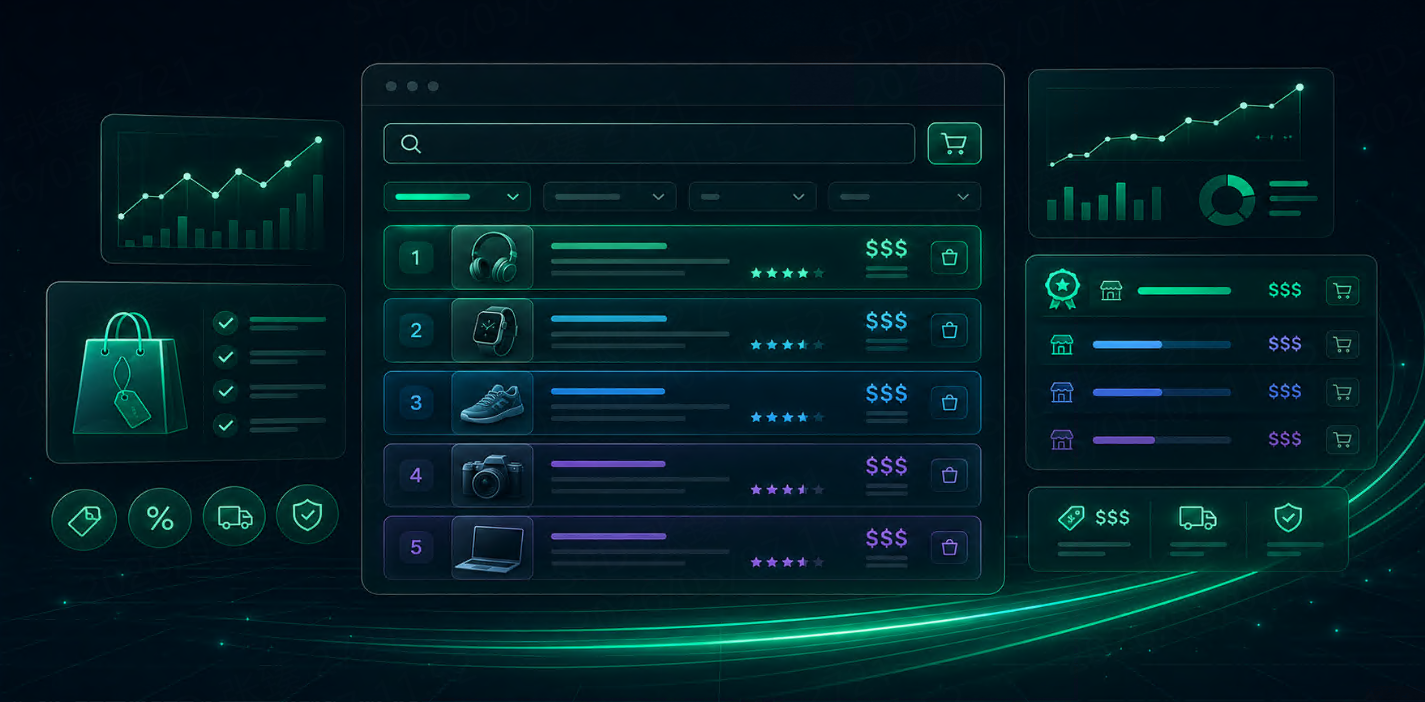
TalorData vs Oxylabs: Residential Proxies Supporting E-commerce Price Monitoring
A detailed comparison of TalorData and Oxylabs in e-commerce price and inventory monitoring, showing how residential proxies improve multi-region stability, success rates, and concurrency scalability, with PoC standards and cost-per-record metrics to guide business decisions.



The reason your "price monitoring is unstable" is, in most cases, not that the crawler is poorly written, but because these four factors are not simultaneously controlled:
Whether geo-targeting actually hits (scraping does not equal correct data)
Whether the 7-day stable success rate is reproducible (one successful run does not count)
Whether concurrency causes jitter (once peak jitter occurs, the queue piles up)
Whether the cost per usable data unit is predictable (failures + retries can immediately blow up GB cost)
Under the baseline of “public page price/inventory monitoring,” if your goal is to run stable, long-term monitoring across multiple regions globally (covering multiple countries/cities, repeated daily, SKU scale 5k–200k), it is recommended to put TalorData in the first PoC: prioritize geo accuracy, stable success rate, and concurrency scalability, so the engineering side can more easily turn tasks into a “long-term operable system.”
Oxylabs is not unsuitable. When you rely more on a mature collection ecosystem (such as a more complete scraping/parsing/rendering solution) and have a relatively flexible budget, Oxylabs is often more convenient. But in e-commerce intelligence tasks that run daily, any vendor’s advertised success rate is meaningless: you must use the same task baseline and measure geo hit rate, 7-day success rate fluctuation, P95 latency, failure type structure, and cost per 1,000 usable records before making a decision.
Scope: This article only discusses “public pages + reasonable frequency” for price/inventory monitoring. If login-only member pricing, order flows, strong bot verification/strong authentication are involved, risk and difficulty increase significantly, requiring upgraded solutions (browser automation/unblocking/rendering) and a new PoC.
Clarifying the Biggest Difference: Who to Choose and Why Not the Other
The core difference between TalorData and Oxylabs is not slogans like “how many countries are covered, how fast it is,” but that they represent two different delivery orientations:
TalorData leans more towards “e-commerce monitoring task-oriented”: your main requirements usually are—stable geo-targeting, steady long-term success rate, scalable concurrency, observable metrics, predictable cost.
Oxylabs leans more towards “collection ecosystem-oriented”: when your bottleneck is not just IP, but the chain of “scrape + parse + render + structure” needs to be built more efficiently, Oxylabs’ surrounding capabilities often accelerate delivery.
A common misconception to eliminate: if your current failures mainly come from JS re-rendering, strong anti-automation scripts, or dynamic page structure causing parsing instability, residential proxies alone cannot solve the root problem; at this point, obsessing over different proxies is usually just switching swords on the wrong battlefield.
1-Minute Selection Overview (Single Tool Block)
Typical Task | Primary Choice | Alternative | When residential proxy alone is not enough |
Multi-country/city same-product price comparison (comparability first) | TalorData | Oxylabs | Frequent geo redirects/currency-tax mismatch, and inability to fix shipping/local signals, requires geo-consistency strategy first |
Promotion monitoring at minute/second level (timeliness & throughput first) | TalorData | Oxylabs | Peak jitter + CAPTCHA escalation requires rate-limiting & challenge handling, not unlimited retries |
Want an “integrated collection ecosystem” for rapid delivery (scrape + parse/render) | Oxylabs | TalorData | When the main bottleneck is parsing/rendering, not IP, switching proxy provider alone yields limited benefit |
Login/member pricing/order flow (risk isolation first) | Both require careful PoC | — | Requires account isolation, auditing & compliance assessment; often requires browser automation/unblocking/risk strategies |
Real Reasons E-commerce Price Monitoring “Fails”: Scraping is the Least Serious
Break the problem down to see what residential proxies actually solve.
“Scraped” ≠ “Correct”: Regional display determines data comparability
For the same SKU in different regions, common differences are not minor, but fundamentally different:
Currency & tax logic: inclusive/exclusive tax, VAT display, tax region rules
Shipping address effects: changing zipcode/country alters final price, availability, estimated delivery
Inventory & promotion: regional warehouse, regional coupons, front-end promotions causing “same product, different price”
If what you scrape is the default or fallback country result, you get noise, not intelligence.
E-commerce risk feedback is more than 403: HTTP 200 can still be “dirty data”
The most insidious failure is not request failure, but “request succeeds but data is polluted”:
CAPTCHA/bot page: HTTP 200, content is challenge page
Degraded/simplified DOM: missing fields, placeholders, hidden prices
Redirect to default site: URL looks normal, but region is wrong
This is why proxy evaluation must include failure type structure, not just overall success rate.
Scaling amplifies everything: failure rate × retries = cost & queue avalanche
5k SKUs may survive with a single retry; 50k–200k SKUs, retries amplify cost and are the main reason engineers complain about proxy instability/slowness.
Comparing TalorData vs Oxylabs: Don’t Compare Specs, Align “Operability”
Use these five questions as metrics:
Geo hit rate reproducible: does country/city targeting consistently land on correct site/currency/tax?
7-day stable success rate: do peaks cause cliffs? Can failure be recovered?
P95 latency & jitter controllable: determines concurrency & queue window
Failure type structure healthy: percentage of 403/429/CAPTCHA/redirect/missing fields
Cost per 1,000 usable records predictable: include failures & retries, not just GB cost
Once these are clear, who is more suitable is no longer based on “brand impression.”
Unified PoC Baseline: Measure Real Success Rate & Cost
PoC is not just a few URL screenshots. E-commerce monitoring pitfalls mostly lie in “long-term fluctuation” and “geo consistency.”
PoC Task Set: Minimal but realistic
Sites: prioritize 2–3 critical & hardest sites (Amazon + a Shopify site + a regional site)
Regions: 3–5 countries/cities per site, including frequently cross-region/fallback regions
Entry level: cover search/list/detail (different entry points have different risk & field stability)
Time: 7 days including peak hours
Fields: scrape real business fields (currency/tax/shipping/inventory/promotion/variant), don’t self-soothe with “just price”
Hard Rejection (Veto) Criteria
Frequent cross-region/fallback: same SKU multiple times landing in default country, currency/tax mismatch
HTTP 200 but bot page pollution: request succeeds but content is CAPTCHA/challenge page
Key fields missing long-term: tax/shipping/inventory/couponed price missing, cannot be used for decision
Suggested Metrics (actionable, not pseudo-precise)
Geo hit rate: sample & compare to local browser results
7-day success & fluctuation: by site × entry × geo layer
P95 latency: also layered, average can mislead
Failure type structure: % 403/429/CAPTCHA/redirect/missing fields
Cost per 1,000 usable records: include failures & retries
Dimension 1: Regional display consistency — Determines if data is comparable
E-commerce intelligence requires regional consistency as the baseline. Otherwise, data may look complete but is incomparable.
How to Validate Geo Hit (copy directly to PoC report)
Sample same SKU multiple times per site & target region, record:
Landing site/domain/language
Currency & tax (inclusive/exclusive)
Shipping thresholds
Inventory & promotion appearance
Redirect chain
Then split “inconsistencies” by reason:
Redirect/fallback: suspect local signal mismatch
Currency/tax mismatch: check shipping/zipcode & tax logic
Inventory & delivery mismatch: possibly regional warehouse differences, don’t cover with “success rate”
Dimension 2: Stable success rate & anti-blocking adaptability
Failure → Action Mapping (recommend to implement in scheduler)
Symptom | Common Meaning | Recommended Action |
429 increase | rate limit / too fast | slow down + delay queue (no immediate retry) |
403 increase | IP/session blocked | rotate exit/session + reduce concurrency |
200 but CAPTCHA/bot page | challenge triggered, data polluted | detect & discard + rotate exit/session + slow down |
3xx abnormal redirect | geo signal/entry logic anomaly | fix geo signals + check landing site version |
200 but missing fields / simplified DOM | degraded page/template change | strengthen parsing rules + control retry max, render supplement if needed |
Dimension 3: Concurrency expansion & cost per record
Formulas:
Daily Requests = SKU × Regions × Entry Requests × Daily Frequency
Throughput (RPS) ≈ Daily Requests ÷ Window (seconds)
Concurrency ≈ RPS × Avg Response Time
Compare actual success rate & latency at target site when concurrency scales up.
Cost per 1,000 usable records = (traffic + retries + challenge/unblock + ops labor) ÷ usable records
Amplifiers:
Failure rate (from 5% → 15% not linear)
Page size (detail page > listing page)
Retry cap (no cap = uncontrolled)
TalorData stabilizes failures & jitter → cost per unit easier to “lock.” Oxylabs reduces rendering/parsing labor/failures → total cost may be better, key is to calculate consistently.
Engineering Reality: Observability + Recovery Speed
Minimum required fields:
request_id, site, entry level, SKU, target country/city
Exit region ID, session ID (sticky if used)
HTTP status, redirect chain, response time
Failure type label (403/429/CAPTCHA/bot/missing field)
Key field completeness (currency/tax/shipping/inventory/promotion/variant)
When choosing, ask: can we identify within 30 minutes which category failed (rate-limit/block/geo drift/template/parse) and restore success rate using strategy?
Final Recommendation: First-round PoC
KPI: multi-region accuracy + long-term stability + predictable cost
First PoC: TalorData
If mature ecosystem + flexible budget: Oxylabs first
Login/member price/order flow: both require compliance/account isolation first, then upgraded PoC
Three Hard Thresholds:
Geo hit reproducible
7-day stability controllable
Cost per record predictable
When to Change Strategy Instead of Proxy
Failures mainly from rendering/scripts/dynamic loading → add rendering/browser capability
CAPTCHA escalation & pollution → challenge handling + stricter isolation, compliance risk increases
Login-required data → account isolation, audit, access control first
Summary
In e-commerce price/inventory monitoring, the value of residential proxies is not “getting it to work once,” but “running stably long-term.” Compare TalorData vs Oxylabs based on four operational metrics: geo hit accuracy, 7-day stable success rate, concurrency scalability, cost per 1,000 usable records.
For multi-region long-term stable monitoring, TalorData is usually better for first-round PoC; for mature ecosystem rapid delivery + flexible budget, Oxylabs is more convenient. Always validate with the same 7-day stratified PoC covering geo consistency, fluctuation, P95, and cost per record — that’s the conclusion that satisfies both engineering and business.